
Superscript Generator
Convert regular text into superscript-style text with our Superscript Generator. Enter or paste your text to create raised characters that you can copy and use in supported apps, messages, and documents. Some letters and symbols may not have a direct superscript equivalent, so the output depends on the characters supported by Unicode.
Superscript Generator
Convert supported characters into superscript-style text you can copy and paste.
Unicode does not provide a superscript equivalent for every character. Supported numbers, selected letters, and symbols can be converted. Unsupported characters, spaces, punctuation, emoji, and line breaks remain unchanged. Some mapped letters are Unicode modifier letters, so their appearance may vary by font and app.
How to Use the Superscript Generator
Use the Superscript Generator to turn supported characters into superscript-style text in a few simple steps. You can then copy the result and paste it wherever you need it.
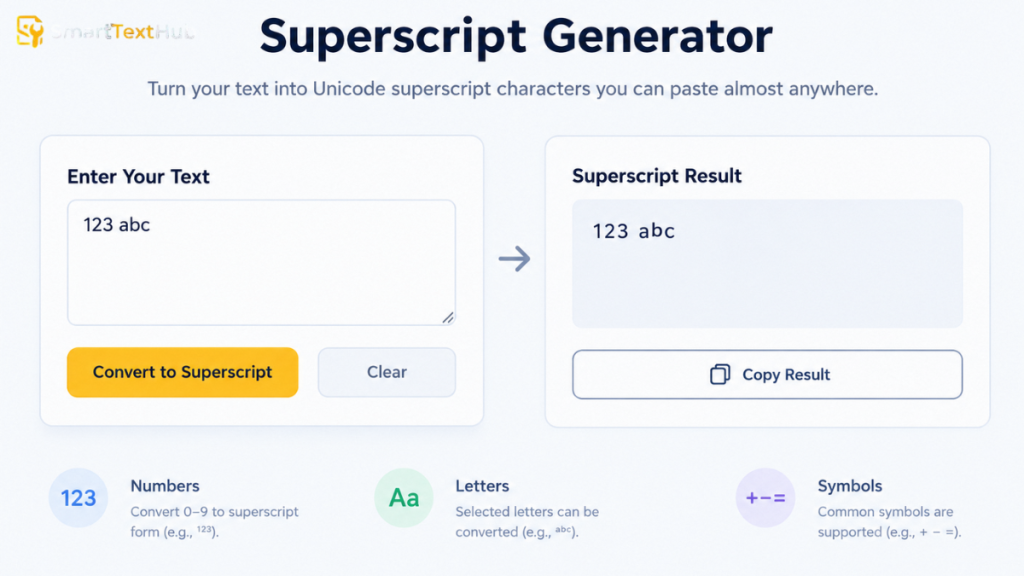
Enter or Paste Your Text
Type your text into the input box or paste it from another source. You can enter words, numbers, or symbols that you want to convert into superscript style.
Convert Your Text to Superscript
Use the generator to convert your input into superscript characters. The available output depends on which Unicode superscript characters correspond to the text you enter. Some letters or symbols may remain unchanged if a suitable character is unavailable.
Copy and Paste the Result
Once your superscript text is ready, copy the result and paste it into a supported app, message, document, or social media profile. The appearance may vary depending on the platform and font, so check the pasted text to make sure it displays correctly.
Superscript Text Examples
Superscript characters appear slightly above the normal text line. They are commonly used for mathematical exponents, references, and other text that needs a raised appearance. The examples below show how regular characters can look when converted to supported superscript characters.
Superscript Numbers and Exponents
Superscript numbers are useful for representing powers in mathematical expressions. For example, x² represents x squared, while x³ represents x cubed. You can also copy individual superscript numbers for use in notes, messages, and other text.
| Regular text | Superscript text |
|---|---|
| 2 | ² |
| 3 | ³ |
| 4 | ⁴ |
| 5 | ⁵ |
| 10 | ¹⁰ |
| x2 | x² |
| x3 | x³ |
Keep in mind that superscript characters are visual text symbols. They do not automatically perform mathematical calculations or replace proper mathematical notation in every context.
Superscript Letters and Symbols
Some letters and symbols also have Unicode superscript forms. These can help you create raised text for references, informal writing, and decorative text.
| Regular text | Superscript text |
|---|---|
| a | ᵃ |
| n | ⁿ |
| i | ⁱ |
| + | ⁺ |
| − | ⁻ |
| = | ⁼ |
| ( | ⁽ |
| ) | ⁾ |
Unicode does not provide a direct superscript equivalent for every letter or symbol. As a result, some characters may remain unchanged during conversion. The way superscript text appears can also vary across fonts, apps, and devices.
Which Characters Can You Convert to Superscript?
The characters you can convert depend on which Unicode superscript characters are available. Many numbers, selected letters, and mathematical symbols have superscript forms, but Unicode does not include a complete superscript version of every character. Understanding these limitations helps you know what to expect from a superscript generator.
Supported Superscript Numbers, Letters, and Symbols
Unicode includes superscript numbers such as ¹, ², and ³, along with other superscript digits, selected letters, and mathematical symbols. These characters can be used in mathematical expressions, references, and decorative text.
Examples include:
The availability of a character depends on the Unicode characters supported by the generator. If you need to convert a full word or sentence, check the output to see whether every character has changed as expected.
Why Some Characters May Not Convert
Not every regular letter, number, or symbol has a dedicated Unicode superscript equivalent. When a matching character is unavailable, a generator may leave the original character unchanged or handle it according to its conversion rules.
Other factors can also affect the result:
- Character availability: Unicode does not contain superscript forms for every character in the alphabet.
- Mixed text: A sentence may contain a combination of converted and unchanged characters.
- Font support: Some fonts cannot display particular superscript characters correctly.
- Platform compatibility: A character that displays correctly in one app may look different or appear as a missing-glyph box in another.
For the most reliable result, review the converted text before copying it. If you need precise mathematical formatting or consistent positioning for every character, HTML superscript formatting may be more suitable than Unicode text.
Common Uses for Superscript Text
Superscript text is useful when you want certain characters to appear above the normal text line. It can help format mathematical expressions, add reference markers, and create distinctive text for online communication. The best use depends on the characters available and the formatting supported by your destination platform.
Math Expressions and Exponents
Superscript numbers are commonly used to represent powers in mathematics. For example, x² means x squared, and x³ means x cubed. They also appear in scientific notation and other mathematical expressions.
A superscript generator can help you create copyable characters for simple expressions, study notes, and informal explanations. However, complex equations may require a dedicated equation editor or mathematical formatting instead of ordinary Unicode text.
Ordinal Numbers and References
Superscript characters can be used to format ordinal endings and reference markers. For example, you might see 1st, 2nd, or 3rd with the endings raised in certain types of writing.
Superscript-style markers may also appear in footnotes or citations. For formal documents, follow the required style guide because superscript formatting conventions vary by publication and context.
Social Media, Messaging, and Profile Text
Superscript characters can add a distinctive appearance to social media bios, usernames where supported, captions, and messages. For example, you might use ² or ³ in a short profile description or use supported raised letters for decorative text.
After generating your text, copy and paste it into the intended app. Keep in mind that not every platform accepts every character, and superscript Unicode characters may not look identical across devices. For important information, prioritize readability over decorative formatting.
Superscript vs. Subscript
Superscript and subscript are two types of text formatting that position characters differently in relation to the normal text line. A superscript appears slightly above the line, while a subscript appears slightly below it. Both are used in mathematics, science, and other forms of writing.
| Feature | Superscript | Subscript |
|---|---|---|
| Position | Above the text line | Below the text line |
| Example | x² | x₂ |
| Common use | Exponents and powers | Chemical formulas and indices |
| Example in context | x² = x × x | H₂O represents water |
When Should You Use Superscript?
Use superscript for mathematical powers, such as x² and x³, or for raised reference markers where appropriate. It can also be useful when you want selected characters to appear raised in messages, notes, or profile text.
When Should You Use Subscript?
Use subscript for expressions such as H₂O in chemistry and x₁ or x₂ when labeling variables or values. It helps distinguish characters that belong below the normal text line.
Unicode Superscript Text vs. HTML Formatting
Unicode superscript text and HTML superscript formatting can make characters appear raised above the normal text line, but they work differently. Understanding the difference helps you choose the right option for your website, documents, messages, or social media posts.
Unicode Superscript Text
Unicode superscript characters are individual text characters that you can copy and paste. Examples include ², ³, ⁿ, and ⁺. They can work in many apps and text fields without requiring HTML formatting.
A superscript generator converts supported characters into these Unicode alternatives. However, Unicode does not provide a superscript equivalent for every letter, number, or symbol, so some characters may remain unchanged.
HTML Superscript Formatting
HTML uses the <escape><sup></escape> element to display content as superscript within a webpage. For example, x<escape><sup></escape>2<escape></sup></escape> can display as x² when the browser renders the HTML.
Unlike Unicode conversion, HTML formatting can raise ordinary characters without requiring a separate Unicode superscript character for each one. However, the formatting works only where HTML is interpreted or rendered; pasting the HTML markup into a plain-text field will not automatically apply the formatting.
Which Option Should You Choose?
| Your goal | Better option |
|---|---|
| Copy and paste raised characters into messages | Unicode superscript text |
| Add superscript formatting to a webpage | HTML <escape><sup></escape> |
| Create simple exponent text for informal use | Unicode superscript characters |
| Format text containing characters without Unicode superscript equivalents | HTML formatting, where supported |
In short: Use Unicode superscript text when you need copyable characters, and HTML formatting when you control the webpage markup. In either case, check the final result in the app or environment where you plan to use it.
Why Superscript Text May Not Display Correctly
Superscript text may look different across devices, browsers, and apps. Although Unicode superscript characters can be copied and pasted like regular text, their appearance depends on the font and character support available in the destination application.
Here are some common reasons why superscript text may not display as expected:
- Missing font support: Some fonts do not include the glyphs needed to display particular superscript characters.
- Unsupported characters: Unicode does not provide a superscript version of every letter or symbol, so some characters may remain unchanged after conversion.
- Empty boxes or question marks: A font or application may show a blank box or replacement symbol when it cannot display a character.
- Different visual appearance: The same superscript character may appear slightly different in different fonts or on different devices.
- App limitations: Some platforms may alter, restrict, or display certain Unicode characters differently.